
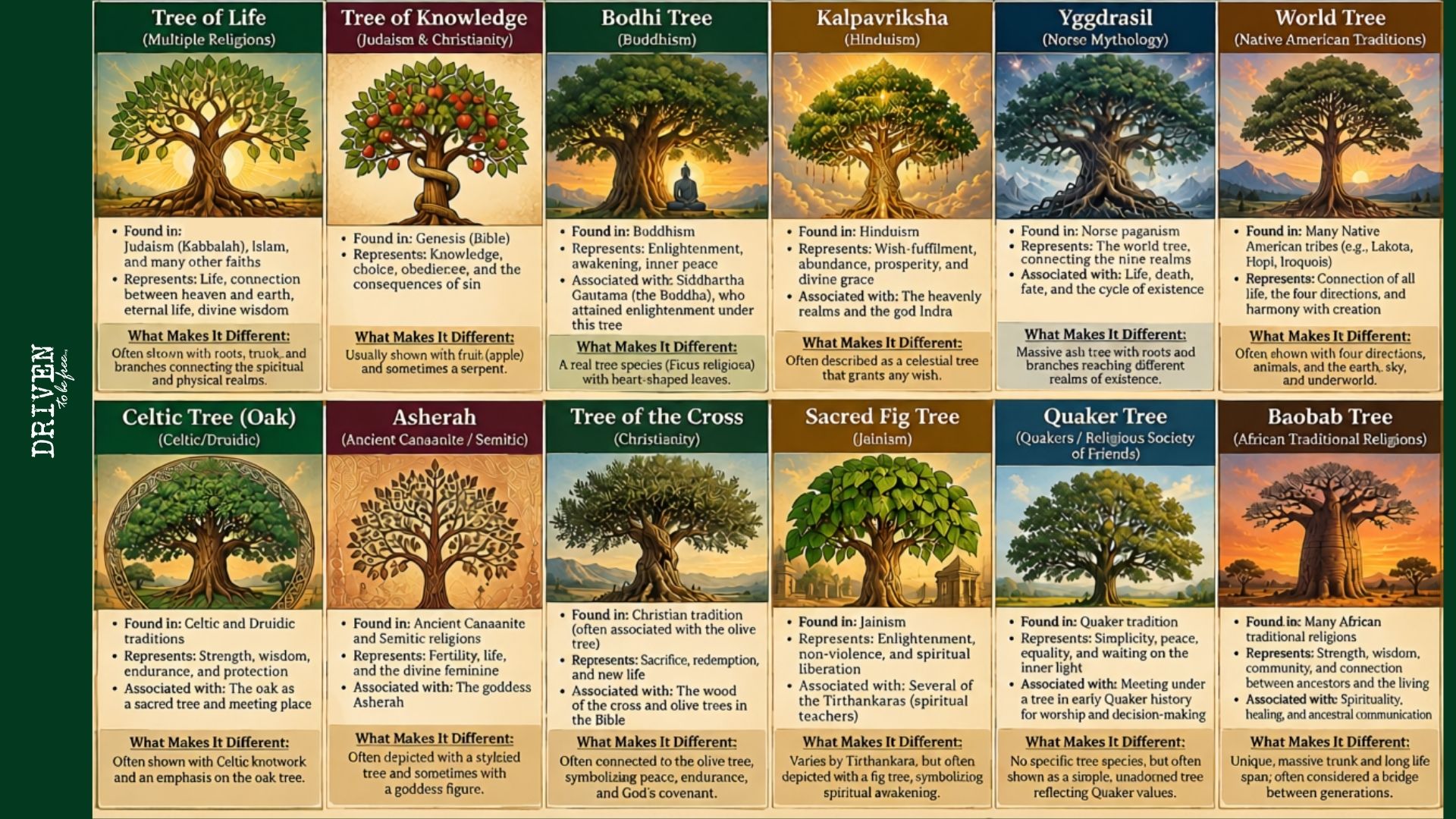
Trees have played a role in worship, prayer, petition, ritual, and sacred symbolism for thousands of years. From the Bodhi tree of Buddhism to sacred banyan trees in Hinduism, Shinto sacred trees in Japan, and Celtic oak groves, trees appear repeatedly in the world's religious traditions.
Admittedly, trees are a wonderful creation! Some of my favorite memories are swinging on vines, jumping from a low branch into a pile of leaves, and swinging on a disc my dad hung from a huge tree at the edge of the woods. My name is carved into a tree in the yard where I grew up. Just the thought of my enjoyment making forts with branches and tapping the sap from a maple brings up great memories.
Trees make specific memories memorable. The importance of trees can be:
- They live for centuries.
- Their roots extend unseen beneath the earth while their branches reach toward the sky.
- They produce food and shelter
- Trees lose their leaves and grow them again
- Trees sometimes survive for generations of human life.
As a result, religions have used trees to represent life, death, rebirth, fertility, wisdom, protection, immortality, divine presence, and the connection between heaven and earth.
Tree Worship
- Sure, some people worship, address, and make trees an idol. However, trees in a worship or connotation mean:
- The location of a sacred location
- The place where an important person visited
- A mark to denote the presence of a deity or spirit
- Commemorating a religious event
- Symbolize what is believed to be a spiritual truth
- A mark of a place where the human and spiritual worlds encounter one another
Why should I even care?
- In the context of deliverance, a tree can provide the means to an open door to bondage. For example, if a person has worshipped, revered or made a vow at a tree, that likely needs to be addressed.
- People who have worshipped trees, may need to renounce the idolatry and repent for breaking the commandment broken. Leviticus 26:1
- Specific “sacred” trees could be tattooed on or collected by a person. In that case, the person would want to renounce and repent. If there’s a collection of pagan sacred objects, then those need to be addressed. Deuteronomy 7:26
- Perhaps the person does not know that they’re opening the door to the demonic or hindering their freedom by continuing in a pagan or antichristian act. Learning what is Holy and what is abominable is important.
Hinduism
The Sacred Peepal and Banyan Trees
Hinduism contains some of the clearest examples of sacred tree rituals. Two particularly important trees are
- The peepal tree (Ficus religiosa), also known as the ashvattha
- The banyan tree (Ficus benghalensis).
The peepal has associations with Hindu deities and sacred literature. Its religious significance is so great that individual trees may become locations for prayer and ritual observance.
The banyan tree is especially important during the Hindu festival known as Vat Purnima or Vat Savitri. The tree's extraordinary longevity makes it an appropriate symbol of long life and marital devotion.
According to the Maharashtra Department of Tourism's description of Vat Purnima, married women traditionally fast and perform rituals honoring the banyan tree while seeking blessings for the well-being and longevity of their husbands.
Rituals may include:
- Tying sacred threads around the trunk of the banyan tree
- Offering flowers, coconut, and turmeric
- Reciting prayers, hymns, or mantras
- Walking around the tree in parikrama, or ritual circumambulation
- Fasting as part of the observance
- Petitioning for the health and long life of one's husband
The Government of India's Utsav tourism portal likewise describes women tying threads around the banyan tree while praying for their husbands' health and longevity.
This is an important example of the distinction between merely using a tree as a symbol and actually performing a religious petition and ritual at a sacred tree.
Buddhism
The Bodhi Tree and Enlightenment
One of the most famous sacred trees in world religion is the Bodhi tree.
According to Buddhist tradition, Siddhartha Gautama, who became known as the Buddha, attained enlightenment while meditating beneath a Ficus religiosa tree at Bodh Gaya, India. Because of this event, the Bodhi tree became a major symbol of enlightenment, awakening, wisdom, and the Buddha himself.
The UNESCO World Heritage Centre recognizes the Mahabodhi Temple Complex at Bodh Gaya as one of the most important Buddhist pilgrimage sites. A Bodhi tree growing there is traditionally regarded as descended from the tree beneath which the Buddha attained enlightenment.
Buddhist pilgrims travel to Bodh Gaya to meditate, pray, chant, make offerings, and perform religious ceremonies near the sacred tree.
Although Buddhists do not generally regard the Bodhi tree as a creator god, this is not an activity that a believer in Jesus Christ would participate in. However, Christians joining in to chant, pray, or make offerings at Bodh Gaya are participants in what a believer would consider idolatrous and antibiblical.
Shinto
Sacred Trees and the Presence of Kami
Kami are the divine or spiritual beings central to Shinto belief. A sacred tree may be called a shinboku, meaning "divine tree."
According to the Encyclopedia of Shinto from Kokugakuin University, a shinboku can be regarded as a sacred tree, a symbol of sacred territory, or a place in which kami dwell.
Sacred trees are often extremely old or unusually large. Rather than cutting them down, people preserve them and may mark them with a shimenawa, a sacred braided rope placed around the trunk. The rope visibly identifies the tree as belonging to sacred space.
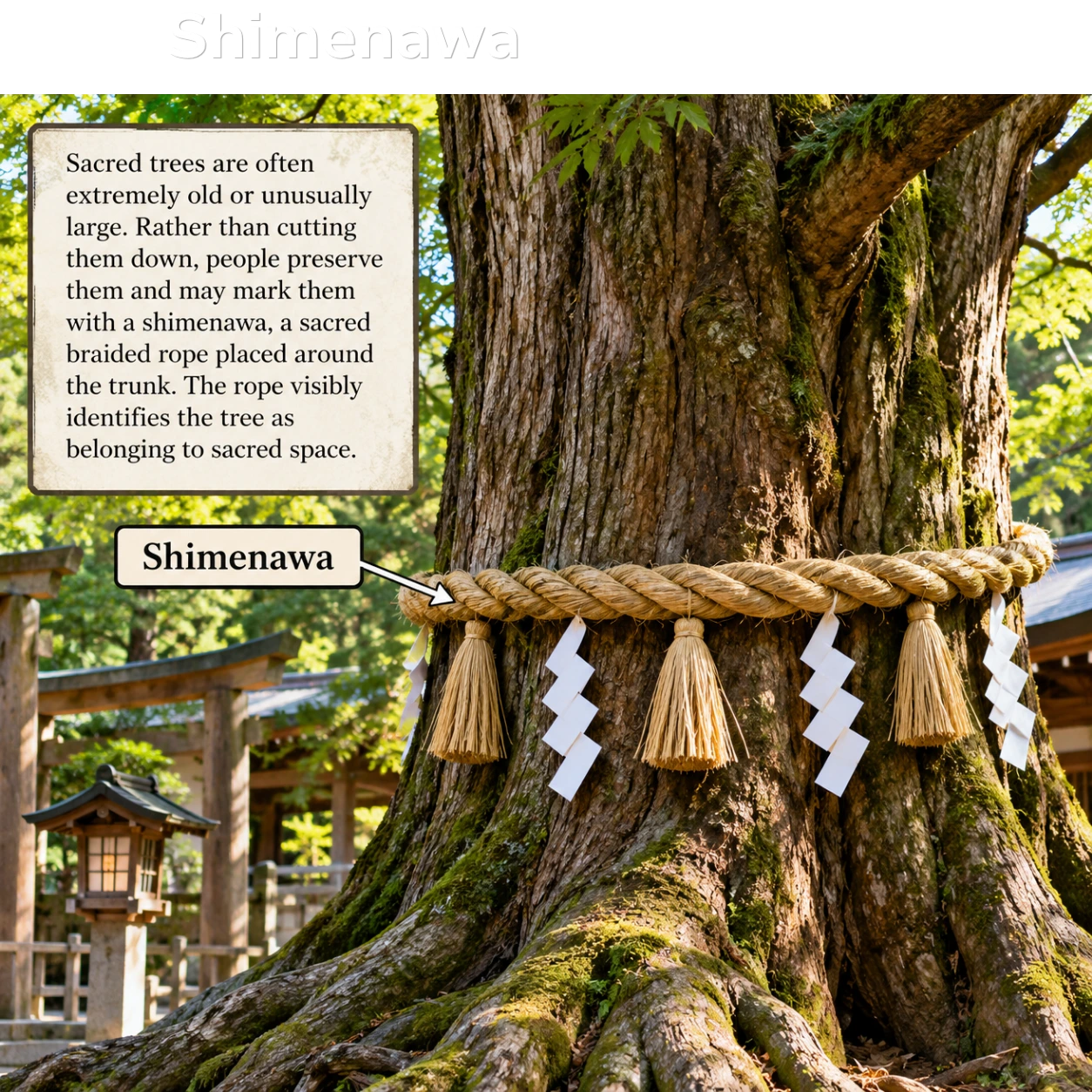
The Encyclopedia of Shinto notes that sacred trees and even entire groves have been revered at Shinto shrines since ancient times and that such trees are frequently surrounded by sacred ropes or enclosures.
The value of the sacred Shinto tree lies primarily in sacred presence, purity, protection, and connection with the kami.
Ancient Celtic Religion and Druid
Sacred Oak Groves
Trees and forests were also important in ancient Celtic religion, and the oak tree became particularly associated with Druids and Celtic religious tradition.
The Oxford Dictionary of Celtic Mythology notes the strong association between Druids and the oak and reports that oak veneration was widespread among Celtic peoples. The Celtic settlement of Drunemeton in Galatia was even described as an "oak sanctuary." See Oxford Academic's discussion of the oak in Celtic religion.
One of the best-known ancient descriptions comes from the Roman writer Pliny the Elder, who described Druids gathering mistletoe from an oak in a religious ceremony. In his account, the mistletoe was cut, and two white bulls were sacrificed.
Ancient Celtic religion also made use of sacred groves, natural areas that could function as places of worship, ceremony, ritual gathering, and offerings.
Christianity
The Tree of Life and Christian Tree Symbolism
Trees appear repeatedly throughout the Bible and Christianity, but traditional Christian teaching does not direct believers to worship, pray to, or petition trees.
The Tree of Life appears near both the beginning and the end of the Bible. It is present in the Garden of Eden in Genesis and appears again in Revelation 22.
The Dictionary of Bible Themes at Bible Gateway identifies the Tree of Life in Genesis and Revelation and explains its association with life and salvation.
Other biblical passages use trees to represent righteous people, spiritual fruitfulness, kingdoms, judgment, restoration, and God's provision.
Wiccan
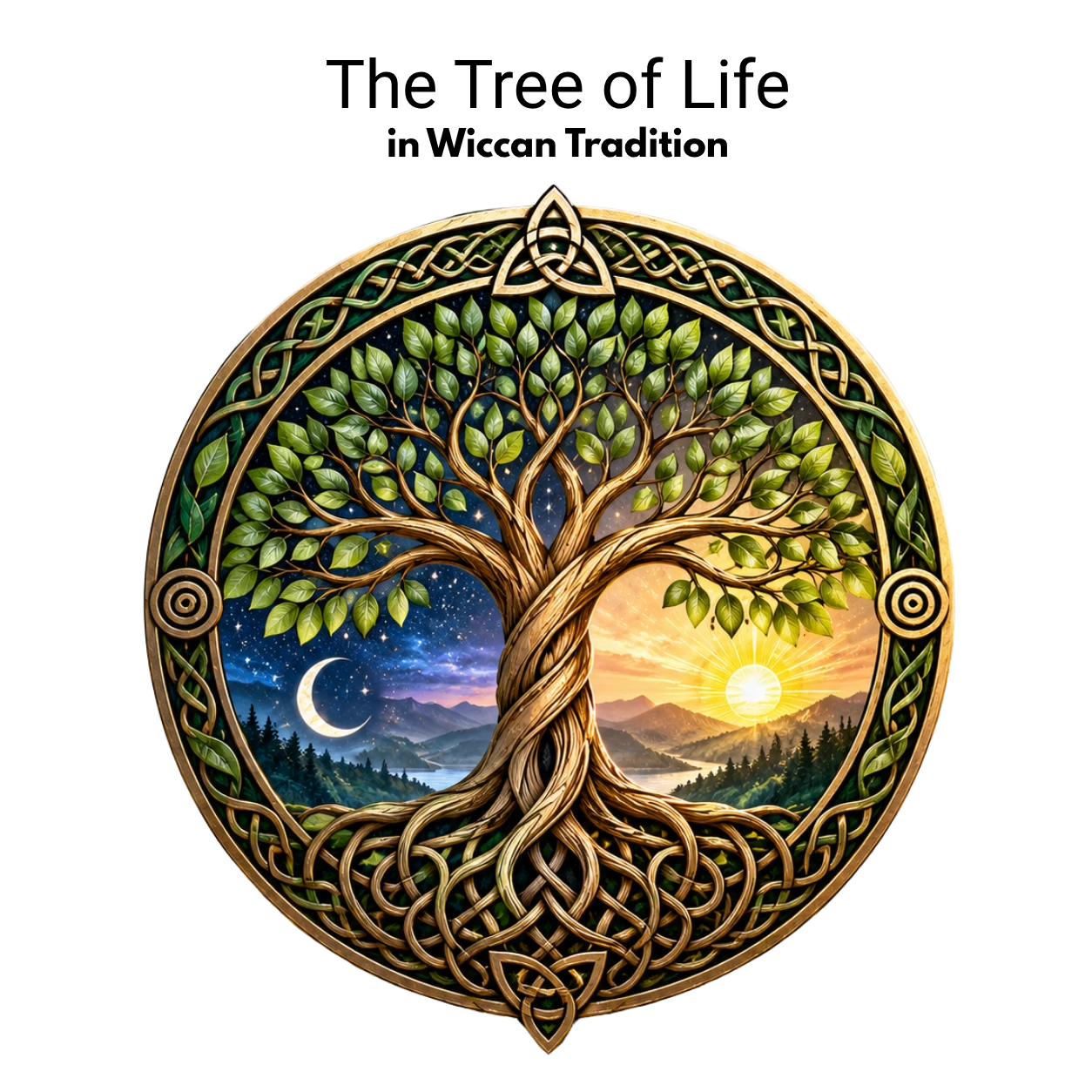
The Tree of Life in Wiccan & Modern Pagan Symbolism
The Tree of Life is also a symbol in Wiccan spirituality and modern pagan traditions. It represents the interconnectedness of all life, the balance of nature, and the unity between the earth, the spiritual realm, and the cycles of birth, death, and rebirth.
Its roots reach into the earth (the physical world), its trunk represents the connection between worlds, and its branches reach toward the heavens (the spiritual realm).
I have had some experience with a believer who liked trees, but always tended to pick out or paint the ones whose symbols were occultic. She was not only trained in the occult as an artist but she was trained on how to mediate on the painting and cause open doors to the occult to transpire.
When she drew the tree of life, it always come out looking more like the the occult tree of life. It always had light behind it and there were issues with the the branches often looked more like snakes.
The Bible says this about the real tree of life:
Revelation 2:7
7 “He who has an ear, let him hear what the Spirit says to the churches. To him who overcomes I will give to eat from the tree of life, which is in the midst of the Paradise of God.” ’ NKJV
Not every tree claiming to be the tree of life is THE Tree of Life!
What’s in a Tree
Just because a symbol is familiar does not mean that it means what you think it means. Even the cross associated with Christianity may not be what you think. Some versions of a cross are pagan, like the Ankh. Some unsuspecting Christians are wearing pagan symbols around their necks, thinking they are adorned with a symbol of their faith. But, a careful inspection of the ornament may prove the item is not what they think it is.
Likewise, choose your trees wisely if you care about the type of objects or symbols permitted in your home.
What To Do
I co-lead a deliverance meeting once per month. We covered the topics of trees this week. After we got off the phone, the other leader messaged me with a picture I’m going to import below. She said, “Lisa, I have this keychain. Did you give it to me?”
I said, “No, I did not.”
“Well, I have it and I think it is of a Druid nature.”
I said, “I think you are right.”
She got rid of that thing, and the next day she said, “You are not going to believe how good I slept last night!” It is true that objects that contradict our faith can cause an unsettling in the spirit and in the home.
- If you find that you have an object, tattoo, painting, or garment with a demonic or idolatrous symbol, here is what you can do.
- Repent for possessing the item.
- Renounce its meaning and position in your life through the blood of Jesus.
- If it’s a tattoo, simply place your hand over it and ask the Lord to sever any ties or connections to the cult or to any demon. Command those spirits to go and dedicate your body to the Lord.
- If the item is an object, ask the Lord what He would like you to do with it. Most of the time, He will instruct you to remove or destroy the item. Just listen, and He will say.
- If any part of you starts feeling heavy or deeply sad, command whatever was connected to the object to go, and declare Jesus as Lord.
Note: If you purchase a home and feel darkness in an area of your yard, you may want to ask whether something is attached to a tree. They last a long time and could have been exposed to several spiritual problems. Don’t be afraid or overwhelmed. Just follow the instructions above and do what He says to do! Cleaning up our land and home can be a very rewarding event!