
We have all experienced it: a sudden, sharp comment from a coworker, a dismissive glance from a spouse, or an unexpected betrayal by a friend. In an instant, something shifts inside us. Long before we have time to logically process the hurt, our mind and body have already reacted.
If we misunderstood the behavior, we can fly off the handle or sulled up before we realize our response is over the top or unwarranted.
These rapid, involuntary reactions are strikingly similar to a fascinating biological quirk most of us have witnessed firsthand.
The Mystery of the Pruney Fingers
Last week, I went swimming with some friends.. We spent hours splashing around, talking, and enjoying the water. Eventually, a young girl in the pool lifted her feet above the surface, gasped, and looked at me in a panic.
"Look! What’s wrong with my feet?" she asked.
I laughed. "They're just pruney!"
"But why?" she pushed back.
I gave her the standard answer most of us grew up believing: "I think it’s just because they're waterlogged. Your skin absorbs the water."
She paused, thought about it, and asked a question that completely stumped me: "Then why isn't my entire body pruney?"
I had never thought about it before. After a quick google search, we were all amazed. Scientific research revealed a fascinating truth: skin wrinkling isn't a passive result of water absorption. It is believed to be an active, involuntary response controlled by the autonomic nervous system. Scientists believe our fingers and toes develop these distinct ridges—much like the treading on rain tires—to help us grip objects better in wet environments.
Our bodies perform these complex, protective adaptations completely behind the scenes, without a single conscious thought from us.
This biological phenomenon beautifully parallels a spiritual and emotional reality. Just as our nervous system automatically alters our skin to adapt to a wet environment, our souls and bodies deploy automatic defense mechanisms the moment we encounter the painful "waters" of offense. In the realm of deliverance and emotional healing, recognizing these automatic responses is the first step toward true freedom.
8 Automatic Responses to Emotional Pain
When offense strikes, we don't usually sit down and plan our strategy. Instead, our internal "software" runs an automatic script designed to protect us from further hurt. Here is an analysis of eight common automatic responses, the scriptures that address them, and practical tips to overcome them.
1. The Instant Wall (Emotional Withdrawal)
This is a sudden, automatic shutting down of warmth or communication. Without making a conscious decision, a person might go completely quiet, give the "silent treatment," or mentally check out of the room just to guard their heart.
The Spiritual Reality: While a wall feels safe, it acts as a prison that locks out healing and isolates us from the body of Christ.
Scripture: "A brother offended is more unyielding than a strong city, and quarreling is like the bars of a castle." (Proverbs 18:19, ESV)
Overcoming Tip: Acknowledge the wall. Instead of completely shutting down, practice saying, "I am feeling overwhelmed right now and need a few minutes to process this, but I want to talk through it." You could say, "Holy Spirit, you are my comforter. I refuse to shut you out along with everyone else." Article on Inner Vows that can come with the wall.
2. Reflexive Defensiveness
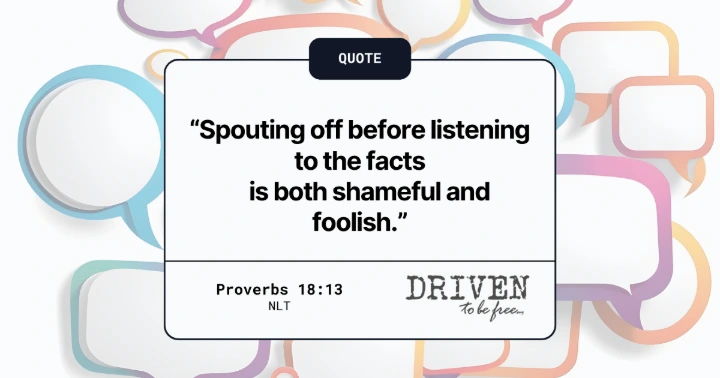
An immediate, sharp counter-attack or justification before fully hearing the other person out. It is the conversational equivalent of a knee-jerk reaction.
The Spiritual Reality: Defensiveness stems from a fear of being exposed or deemed unworthy. When we rush to defend ourselves, we strip God of His role as our ultimate Defender.
Scripture: "Good sense makes one slow to anger, and it is his glory to overlook an offense." (Proverbs 19:11, ESV)
Overcoming Tip: Take a deep breath and commit to a "ten-second pause" before replying. Ask yourself: Am I listening to understand, or am I listening to fight back? You could pray and ask the Lord to increase you in the fruit of the spirit so that love and patience arise int he face of adversity.
3. Passive-Aggressive Retaliation
Expressing anger or resentment indirectly rather than addressing the conflict openly. This can manifest as sarcastic remarks, heavy sighing, or intentionally "forgetting" a favor.
The Spiritual Reality: Passive-aggression masks anger with a false veneer of peace, which violates the biblical call for absolute honesty and love.
Scripture: "Rather, speaking the truth in love, we are to grow up in every way into him who is the head, into Christ," (Ephesians 4:15, ESV)
Overcoming Tip: Call out your own undercover anger. Bring the issue into the light with gentle, direct language rather than letting it leak out sideways. Be aware of your heart's motives and assess roots of pride that harbor retaliation.
4. Minimization or Laughing It Off
An automatic deflection where a person quickly downplays the offense, saying "It's fine" or turning a hurtful comment into a quick joke.
The Spiritual Reality: This is an unconscious coping mechanism used to avoid the discomfort of conflict or vulnerability. However, you cannot heal a wound you refuse to admit is there. Minimizing or laughing is a soft redirect that some do without realizing they are doing it!
Scripture: "They have healed the wound of my people lightly, saying, 'Peace, peace,' when there is no peace." (Jeremiah 6:14, ESV)
Overcoming Tip: Give yourself permission to feel hurt. It is entirely acceptable to say, "That comment actually hurt my feelings," rather than masking your pain with a laugh. Check to see if your motive is to avoid embarrassment, to make others feel comfortable at your own expense, etc. Seek the Lord for the root.
5. Over-Explanation and Justification
An involuntary impulse to endlessly explain your actions, motives, or character to the person who caused the offense.
The Spiritual Reality: This stems from a deep, subconscious need for human validation and an urgent desire to correct someone else's negative perception of you.
Scripture: "For am I now seeking the approval of man, or of God? Or am I trying to please man? If I were still trying to please man, I would not be a servant of Christ." (Galatians 1:10, ESV)
Overcoming Tip: Rest in your identity in Christ. Remind yourself that you do not need to win an argument or manage someone else's opinion of you to be secure. Ask the Lord to help you tame your tongue so that you can not speak if you need to be quiet and think.
6. Somatic Tension
The body frequently registers an emotional sting before the conscious mind even realizes what happened. This shows up as a tight jaw, a knot in the stomach, clenched fists, a spike in heart rate, or a sudden flush of heat.
The Spiritual Reality: Our bodies are temples of the Holy Spirit, and they carry emotional weight. Unforgiveness and offense can physically manifest as stress and sickness if left unchecked.
Scripture: "A tranquil heart gives life to the flesh, but envy makes the bones rot." (Proverbs 14:30, ESV)
Overcoming Tip: When you feel your body tightening up, consciously relax your shoulders, unclench your jaw, and give that physical tension over to God in prayer. Wait. Wait for your processing and seeking the truth before allowing the somatic tension to direct you into premature responses.
7. Mental Replay Loop (Rumination)
The mind automatically locks onto the offensive event, replaying the scenario, analyzing the words, and scripting imaginary, devastating comebacks hours, days, or weeks later.
The Spiritual Reality: The brain does this unconsciously to try to regain a sense of control over a situation where it felt entirely powerless. It feeds the roots of bitterness.
Scripture: "We destroy arguments and every lofty opinion raised against the knowledge of God, and take every thought captive to obey Christ," (2 Corinthians 10:5, ESV)
Overcoming Tip: Interrupt the loop. The moment the replay starts, actively replace the thought by praying for the person who offended you. It is incredibly difficult to ruminate on an offense while sincerely blessing someone in prayer.
8. Unconscious Projection
Mirroring the offense right back or immediately projecting your own deep-seated insecurities onto the offender. For instance, if someone points out a flaw in you, you instantly hyper-focus on their worst flaw and let them hear about it.
The Spiritual Reality: Projection is a diversion tactic designed to take the spotlight off our own pain or shortcomings, but it breaks the unity of believers.
Scripture: "Why do you see the speck that is in your brother's eye, but do not notice the log that is in your own eye?" (Matthew 7:3, ESV)
Overcoming Tip: When you feel the urge to attack someone else's character, stop and ask God: What is hurting inside of me right now that makes me want to tear them down? You could also ask, "Lord, show me how you see this person or tell me the truth I need to know."
Moving from Automatic Reflex to Spiritual Response
| Automatic Reflex (The Flesh) | Spiritual Response (The Spirit) |
| Built on self-protection and fear | Built on trust in God’s sovereignty |
| Shuts down communication and isolates | Promotes reconciliation and truth |
| Keeps us trapped in a loop of bitterness | Releases the offender and brings freedom |
Our fingers wrinkling in the pool is a brilliant design meant to help us grip a slippery surface. But when it comes to emotional pain, our automatic, carnal reflexes do the exact opposite—they cause us to lose our grip on peace, joy, and healthy relationships.
True spiritual maturity and deliverance happen when we move from reacting in the flesh to responding in the Spirit. The next time you feel the sting of an offense, look closely at your internal response. Don't condemn yourself for an automatic reaction, but don't let it rule you either. Take a moment, bring that automatic response to the Lord, and allow His grace to smooth out the ridges of your heart.
Take the Quiz
What is your Go-To Offense Process?
For Reflection Purposes. Not for Professional Diagnostics.